Posts

Showing posts from February, 2011

Motorola’s Xoom Tablet

Image
Motorola’s Xoom tablet computer went on sale   last Thursday and looks like this device is  the most powerful rival yet to Apple’s iPad. Though companies like Samsung and Dell have tried to respond with tablets of their own based on Google’s Android operating system, the Xoom is the first tablet to feature the latest Android version, Honeycomb, which is optimised for tablets as opposed to smartphones. The Xoom is roughly the same size as the iPad, and costs about the same for a similarly spec’d version, though buyers who opt for an iPad with limited memory and restricted to wi-fi connections can save hundreds of dollars. The Xoom has slightly higher screen resolution than the iPad, and boasts front and rear facing cameras for picture-taking and video conferencing. Powering the device is a dual core 1GHZ processed with 1GB of RAM, and battery life is assessed at 10 hours. This device seems to be  a worthy competitor to the iPad
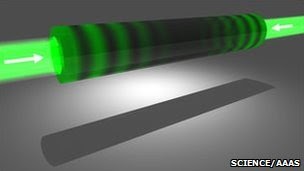
Now we have world's first anti-laser

Image
A team of Physicist at Yale University, have built the world's first device that can cancel out a laser beam - a so-called anti-laser which is capable of absorbing an incoming laser beam entirely. Their device focuses two lasers beams of a specific frequency into a specially designed optical cavity made from silicon, which traps the incoming beams of light and forces them to bounce around until all their energy is dissipated. In a paper published in the journal Science they demonstrated that the anti-laser could adsorb 99.4 per cent of incoming light, for a specific wavelength. Altering the wavelength of the incoming light means that the anti-laser can effectively be turned on and off - and that could be used in optical switches. The anti-laser's big advantage is that it is built using silicon, which is already widely used in computing.

Large Hadron Collider -Update

Image
Large Hadron Collider experiment is on track to discover new physics. On 31 January 2011. CERN announced that the LHC will run through to the end of 2012 with a short technical stop at the end of 2011. The beam energy for 2011 will be 3.5 TeV. LHC’s experiments a good chance of finding new physics in the next two years, before the LHC goes into a long shutdown to prepare for higher energy running starting 2014. The LHC was previously scheduled to run to the end 2011 before going into a long technical stop necessary to prepare it for running at its full design energy of 7 TeV per beam. However, the machine’s excellent performance in its first full year of operation forced a rethink. Expected performance improvements in 2011 should increase the rate that the experiments can collect data by at least a factor of three compared to 2010. That would lead to enough data being collected this year to bring tantalising hints of new physics, if there is new physics currently within reach of the...

Sun is sputtering X-flare

The Sun has unleashed its strongest flare in four years the so-called X-flare, the strongest type; such flares can affect communications on Earth The eruptions are expected to hit the Earth's magnetic field field over the next couple of days, causing an increase in geomagnetic activity. The monster flare was recorded at 0156 GMT on 15 February and directed at the Earth. According to the US space agency, the source of this activity - sunspot 1158 - is growing rapidly. Solar flares are caused by the sudden release of magnetic energy stored in the Sun's atmosphere. Preliminary data from the Stereo-B and Soho spacecraft suggest that the explosion produced a fast but not particularly bright coronal mass ejection (CME) - a burst of charged particles released into space. The unpredictable activity on the Sun can interfere with modern technology on Earth, such as electrical power grids, communications systems and satellites - including the satellite navigation (or sat-nav) s...